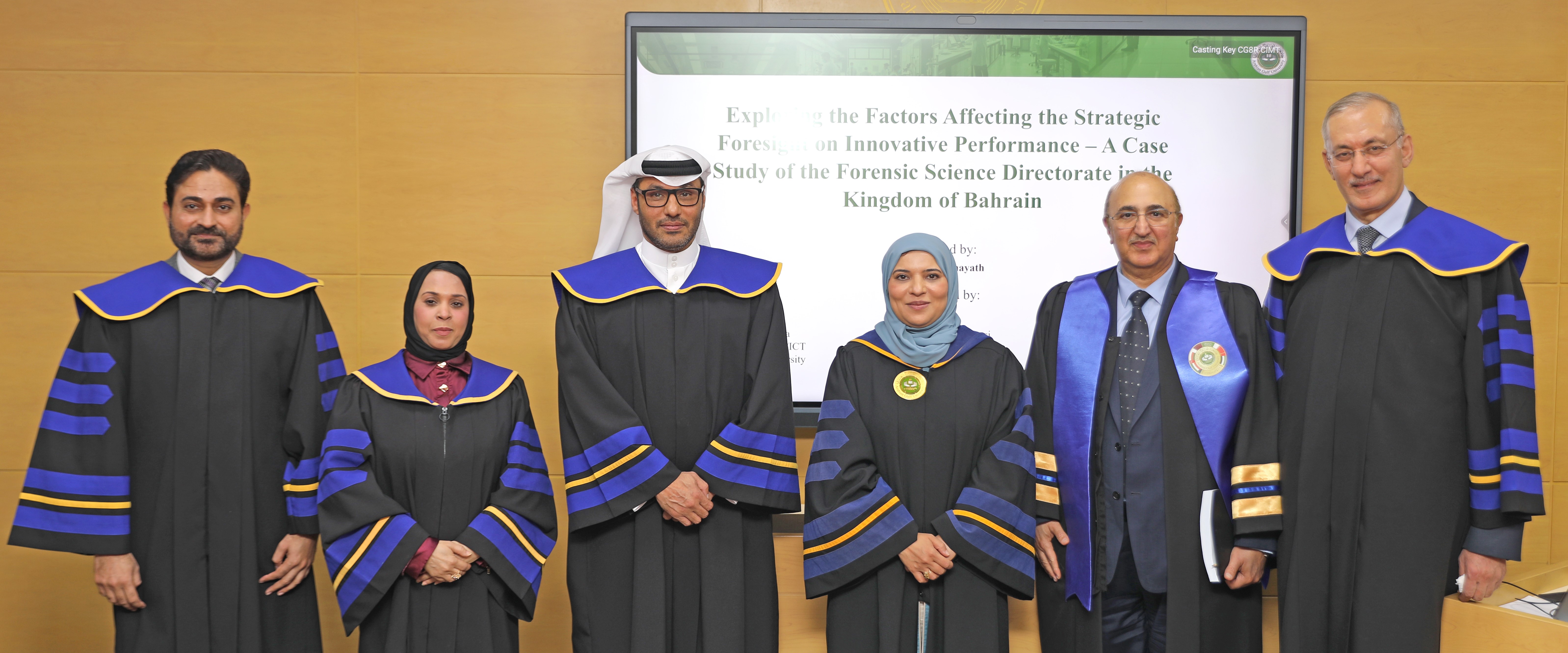
AGU Researcher Publishes Dissertation on Strategic Foresight and Innovative Performance in Forensic Science
Arabian Gulf University
22 Dec, 2025
Researcher Mohammed Abdullah Ghiath from the College of Education, Administrative, and Technical Sciences at Arabian Gulf University (AGU) has defended his doctoral dissertation, which explores the factors influencing strategic foresight and its role in enhancing innovative performance. The study centres on a case study of the Forensic Evidence Department in the Kingdom of Bahrain, fulfilling the requirements for a PhD in Innovation and Technology Management.
The dissertation offers an integrated examination of how strategic foresight fosters innovative performance within security institutions, analysing the effects of internal and external organisational factors on both strategic foresight practices and innovation performance. This study is among the first of its kind in the field of forensic science, making it a valuable addition to security literature while enhancing the scientific and applied understanding of institutional work in this vital sector.
Employing a mixed-methods approach, the study combines quantitative analysis through Structural Equation Modelling (SEM) with qualitative insights from expert interviews, alongside the application of systematic triangulation to enhance the reliability and depth of findings.
The theoretical framework underpinning the research draws on resource theory, knowledge theory, and dynamic capability theory. These theories explain strategic foresight as an organisational capability emerging from effective resource utilisation, knowledge integration, and adaptive capacity.
Findings revealed direct and statistically significant relationships between internal and external organisational factors, strategic foresight, and innovative performance, consistent with the theoretical frameworks. Researcher Ghiath stated, “Internal factors, especially organisational culture, emerged as primary drivers of both strategic foresight and innovative performance. This aligns with resource and knowledge theories, which highlight the importance of culture in facilitating knowledge flows and organisational learning.”
External factors played a supportive role by providing environmental knowledge to inform innovation, consistent with the needs of stakeholders. This reflects the logic of dynamic capabilities theory, which links innovation to an organisation's ability to sense and adapt to environmental changes.
The results affirm that strategic foresight functions as an independent organisational capability that directly enhances innovative performance by fostering organisational readiness, guiding future-oriented thinking, and facilitating the integration of resources, knowledge, and adaptive skills within security agencies.
Qualitative analysis underscored the pivotal role of leadership, particularly transformational and delegative styles, as enablers that cultivate an environment conducive to strategic foresight and innovation. These leadership approaches promote participation, empower units, and encourage knowledge sharing.
Conversely, the study identified barriers such as limited institutional integration, resistance to change, and financial constraints, which can hinder the full realisation of strategic foresight and innovation. These findings highlight the need for a cohesive institutional framework that balances capabilities with existing challenges to sustain these practices.
Concluding with practical recommendations, the researcher emphasised the importance of strengthening organisational culture, enhancing work integration among units, maximising organisational knowledge and stakeholder engagement, and adopting advanced analytical and data tools. These recommendations activate strategic foresight, boost innovative performance, and enhancing institutional readiness to face future challenges.
The research was supervised by Dr Afaf Bugawa, Associate Professor of Information and Communication Technology as Principal Supervisor, alongside Prof Odeh Al Jayyousi, Professor of Innovation Policies, and Prof Waheeb Al Nasser, Professor of Applied Physics.