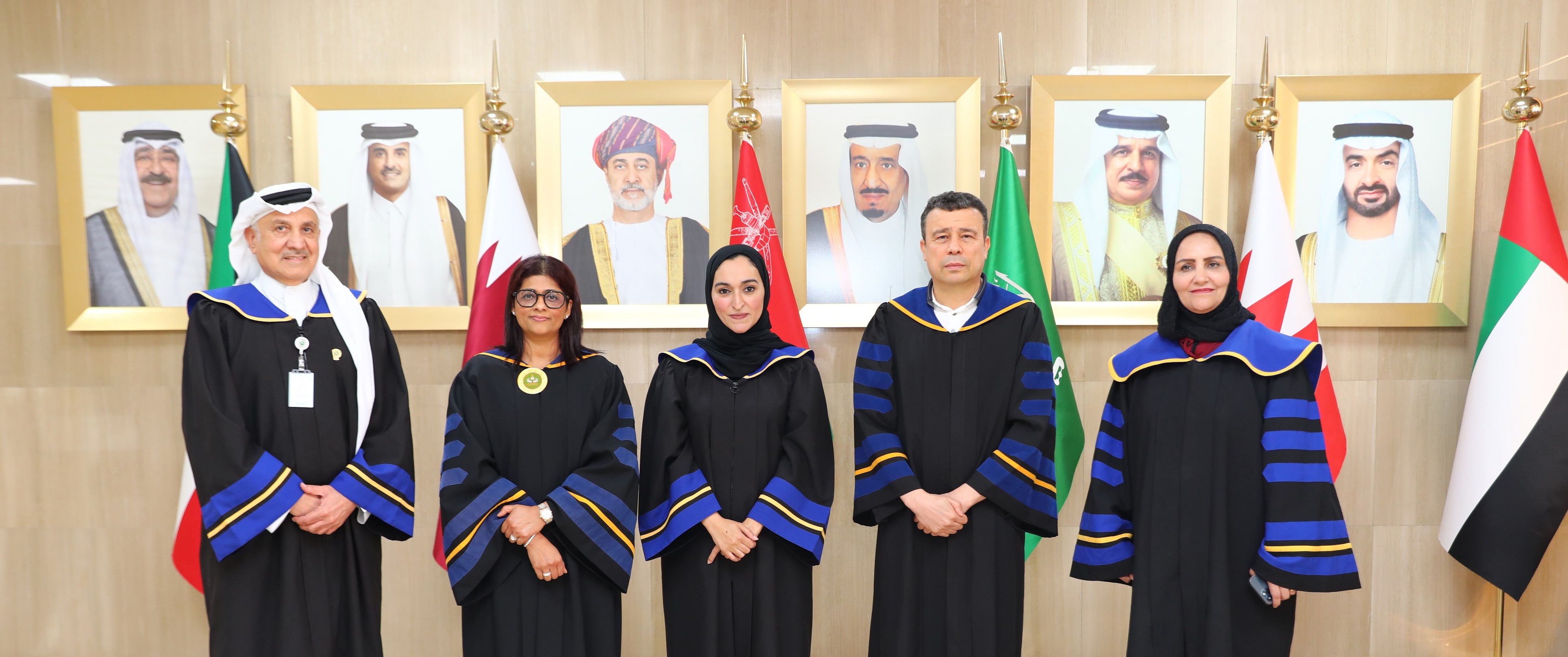
Researcher Al-Ahmad presents a smart model for human resource development in the public sector in a study submitted for her Ph.D. in Innovation Management
Arabian Gulf University
29 Jun, 2026
Shouq Abdulrahman Al-Ahmad, a researcher in the Department of Innovation and Technology Management at the College of Education, Administrative and Technical Sciences at Arabian Gulf University, defended her doctoral dissertation titled: “Exploring the Impact of Integrating Artificial Intelligence on the Future of Innovation in Human Resources in Public Sector Institutions in the Kingdom of Bahrain,” as part of the requirements for obtaining a Ph.D. in Innovation Management at Arabian Gulf University.
The study aimed to explore the factors influencing the integration of artificial intelligence into human resources practices in the public sector, and to analyze its impact on the future of jobs, skills, and competencies in light of digital transformation and labor market demands, using a mixed-methods research approach—combining quantitative and qualitative methods—including interviews with 14 subject-matter experts and a survey of 307 employees at various job levels in the public sector.
The results revealed a set of factors influencing the integration of artificial intelligence, including AI governance, the level of readiness among human resources staff, and organizational, technical, and human challenges, in addition to its impact on the future of work. The study also highlighted a gap between certain quantitative and qualitative indicators, particularly regarding the role of organizational culture, management support, and technical readiness—despite their importance to the success of the integration process.
The most notable outcome of the study was the development of an innovative prototype called “AI Talent Builder,” an intelligent system designed to identify required competencies, analyze competency gaps, assess training needs, and propose customized training plans for human resources staff in the public sector.
Researcher Al Ahmed noted that the model is distinguished by its ability to continuously learn from employee data and reliable sources, making it a dynamic tool that adapts to changing circumstances and evolving requirements. It also provides an interactive dashboard that visually displays performance indicators and gap analysis, helping decision-makers direct training investments toward the priorities with the greatest impact.
She added that this model adds value by automating the analysis of training needs, standardizing the human resources competency framework, and supporting data-driven decision-making in human capital management, thereby contributing to improved institutional performance and the quality of public services. It can be applied across various public sector institutions, thereby enhancing the integration of training efforts and standardizing competency criteria at the national level.
For his part, the Primary Supervisor, Head of the Computing Department and Professor of Computer Science, Cybersecurity, and Artificial Intelligence at the College of Education, Administrative and Technical Sciences, Prof. Dr. Adel Bouhoula, emphasized that this model represents a quantum leap in the application of artificial intelligence to human resources management, by transforming training needs analysis from a traditional process into a dynamic, data-driven, intelligent system that supports decision-making, in line with the objectives of Bahrain Vision 2030 aimed at promoting innovation, enhancing government performance efficiency, and developing national human capital. He added that this study is considered one of the pioneering research projects in the region that integrates artificial intelligence with human resources management in the government sector, opening up new horizons for research and development in this field.
The examination committee consisted of Prof. Dr. Fawzia Jabin, Professor of Sustainability, Innovation, and Entrepreneurship at the United Arab Emirates University, serving as an external examiner, and Prof. Dr. Adel Al-Alawi, Professor of Business Administration and Information Systems at the Arabian Gulf University, serving as an internal examiner,
while the supervisory committee consisted of Prof. Dr. Adel Bouhoula, Professor of Computer Science, Cybersecurity, and Artificial Intelligence at the College of Education, Administrative and Technical Sciences, as chief supervisor, and Prof. Dr. Fayrouz Al-Damour, Professor of Management Information Systems in the Department of Business Administration at Arabian Gulf University, as co-supervisor.