Research at AGU Reveals Mechanisms of Ovarian Cancer Resistance and Contributes to Precision Medicine
Arabian Gulf University
22 Mar, 2026
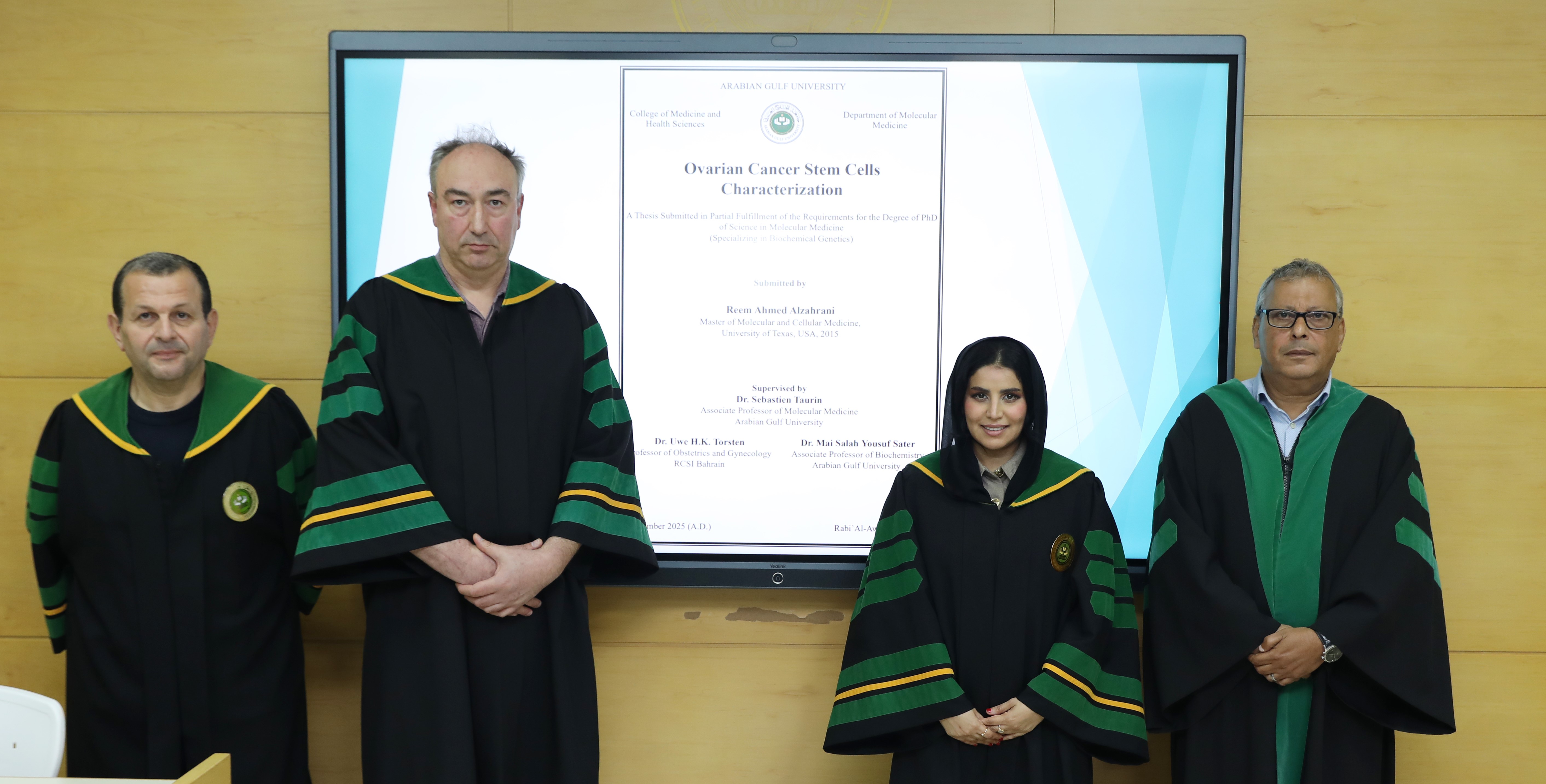
An applied study has recently identified key mechanisms behind ovarian cancer’s resistance to treatment. This was achieved through the development of a three-dimensional organoid platform that accurately replicates the environment which incubates cancer stem cells and effectively targets them, thus contributing to modern trends in precision medicine. The findings were presented as part of a doctoral dissertation in molecular medicine titled "A 3D Organoid Platform for Modelling and Targeting Ovarian Cancer Stem Cells" prepared by researcher Reem Ahmed Al-Zahrani at Arabian Gulf University (AGU).
The 3D organoid platform is an advanced biological model created from cells taken from the tumour itself. These cells are grown in the laboratory within an environment that mimics the spatial and functional structure of the original tissue, including cell interactions and surrounding molecular signalling networks. This model provides researchers with a more precise ability to study tumour behaviour and test treatment responses under conditions closer to the patient's biological reality.
The study demonstrated that ovarian cancer stem cells, particularly CD44+ cells, play a pivotal role in chemotherapy resistance and relapse due to their location within microenvironments that contribute to their survival and the activation of complex biosignature networks.
The results also indicated that traditional 2D models do not accurately reflect this structural complexity, while 3D organoids successfully preserved the cells' spatial structure and molecular pathways.
The study revealed the limited effectiveness of conventional chemotherapy in eliminating these protected cells, in contrast to the promising results of targeted therapies. The medication Dasatinib demonstrated the ability to disrupt stem cell positions and enhance their sensitivity to treatment, while panobinostat targeted stem cell reprogramming by disrupting key molecular pathways such as LGR5-Wnt, which are associated with maintaining stem cell characteristics.
Targeted therapies are drugs designed to target specific molecules or pathways within cancer cells responsible for their growth or survival. Unlike traditional chemotherapy, which generally affects rapidly dividing cells, targeted therapies offer greater precision and a relatively lower impact on healthy cells.
The LGR5-Wnt pathway regulates cell division and renewal which plays a crucial role in maintaining the stem characteristics of cancer cells. When this pathway is overactive, it contributes to stem cell survival and resistance to treatment, making its disruption a promising therapeutic target.
Notably, organoids derived from real patients reflected a clear variability in treatment response from one case to another. This strengthens the potential of this platform to predict the most appropriate treatment for each patient and supports the application of personalised medicine in the treatment of gynaecological cancers.
The dissertation was completed as part of the PhD programme in Molecular Medicine, under the supervision of Dr Sebastien Taurin, Associate Professor of Molecular Medicine at AGU. The examining committee consisted of External Examiner Dr Uwe Torsten, Professor of Obstetrics and Gynaecology at the Royal College of Surgeons in Ireland – Medical University of Bahrain, and Internal Examiner Professor Diaa Rizk, Head of the Department of Obstetrics and Gynaecology at AGU.