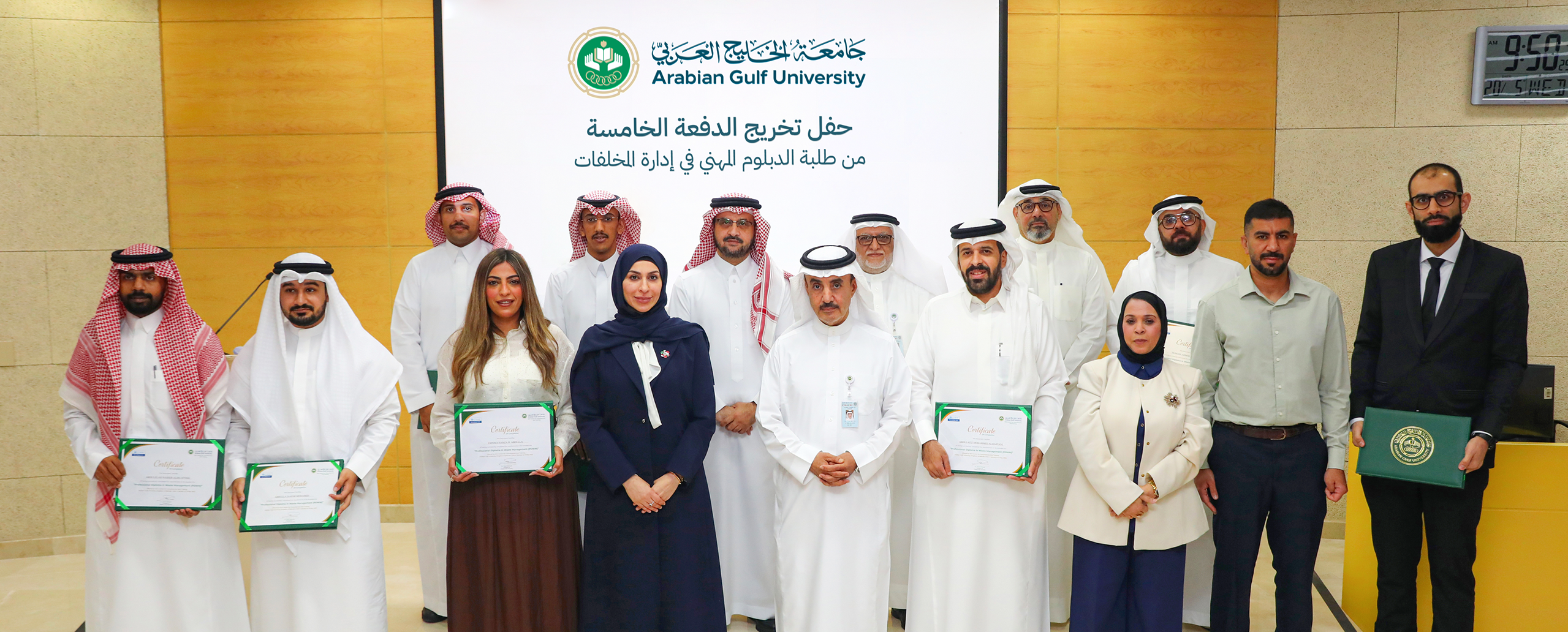
Arabian Gulf University Graduates 15 New Gulf Experts in Waste Management
Arabian Gulf University
20 May, 2026
The Arabian Gulf University has graduated 15 experts from the Gulf Cooperation Council (GCC) countries as part of the fifth cohort of its Professional Diploma Program in Waste Management, bringing the total number of graduates since the program’s inception in October 2021 to 106.
His Excellency the University President, Dr. Saad bin Saud Al-Fahaid, emphasized during his patronage of the graduation ceremony that the university continues to develop high-quality programs that meet the needs of the Gulf labor market and contribute to preparing specialized professionals capable of supporting the waste management sector, enhancing resource management efficiency, and preserving the environment.
On this occasion, His Excellency extended his deepest thanks and gratitude to Their Majesties and Highnesses, the leaders of the Gulf Cooperation Council (GCC) countries, for their continued support of education and development, and for their commitment to empowering Gulf competencies and promoting scientific initiatives that contribute to achieving sustainable development in the region. He noted that growing environmental challenges make the training of specialized competencies a development priority, emphasizing the program’s role in preparing experts capable of keeping pace with modern transformations in the fields of sustainability and the circular economy, and contributing to achieving a balance between economic development and environmental protection.
For her part, Dr. Afaf Bougui, Director of the Center for Community Service, Consultancy, Training, and Continuing Education, reaffirmed the Center’s commitment to its pivotal role in preparing and qualifying national and Gulf cadres through training programs and professional diplomas that keep pace with future transformations across various sectors, and continuing to adopt effective initiatives and partnerships with government and private entities, thereby contributing to the development of skills and the building of specialized competencies capable of supporting sustainable development pathways and serving the Gulf community. She expressed her delight at the achievements of the professional diploma programs, such as the Professional Diploma in Water Management, the Professional Diploma in Waste Management, the Innovative Development Diploma (STEM), the Innovative Development Diploma in Autism Spectrum Disorder, the Professional Diploma in Endowment Investment, and the Professional Diploma in Cybersecurity, all of which represent a qualitative addition to the university’s academic and developmental journey.
In the same context, Dr. Sumaya Yusuf, the academic coordinator of the Professional Diploma Program in Waste Management and an assistant professor of environmental engineering at the Center for Environmental and Biological Studies, noted that the program is considered one of the leading programs in the Gulf and the Arab region, as it focuses on preparing professional cadres in the sustainable management of resources and waste and the circular economy, thereby contributing to enhancing resource management efficiency and transforming environmental challenges into promising investment and development opportunities, in support of the Sustainable Development Goals.
She noted that the program has received international accreditation for the second consecutive year from the Chartered Institute of Waste Management (CIWM) in the United Kingdom, making it the first program of its kind in the Gulf and the Arab region to achieve this accreditation, in addition to receiving support from the United Nations Environment Programme – West Asia Office. She highlighted the program’s key achievements, including the organization of the first forum for graduates of the Professional Diploma in Waste Management in collaboration with the Abu Dhabi Recycling Center, the launch of the “Gulf Network of Resource Managers” initiative, and the program’s participation in a number of international and regional forums specializing in the fields of environment and sustainability.
Speaking on behalf of the graduates, Abdulelah Al-Matash said that the program provided a unique academic and professional experience that raised their awareness of the importance of sustainability and environmental protection and reinforced their understanding of waste management as a key element in building more efficient cities and more sustainable economies. He noted that the program helped broaden their perspective on their environmental and social responsibilities by focusing on the concepts of the circular economy and environmental sustainability, and by transforming environmental challenges into opportunities for development and innovation, thereby keeping pace with global changes and enhancing quality of life.
He cited examples of graduates who have made a significant impact, noting that one graduate from the previous cohort had risen to the position of Assistant Deputy Minister at the Ministry of Municipalities and Housing—an example that underscores the value of investing in national talent and the role of specialized professional programs in preparing future leaders, noting that completing the program marks the beginning of a new phase of responsibility for graduates to serve their countries and communities and contribute to building a more sustainable and conscious future, in line with their countries’ development aspirations and future visions.