
Arabian Gulf University Confirms the Success of Its Research Collaboration with “Danat” in Mapping Pearl Oyster and Seagrass Habitats in the Territorial Waters of the Kingdom of Bahrain
Arabian Gulf University
07 Jul, 2026
Dr. Sabah Al-Junaid, Associate Professor of Geographic Information Systems and the Environment and Academic Supervisor of the His Highness Shaikh Hamad bin Khalifa Al Thani Chair in Geographic Information Systems, affirmed the success of the research partnership with the Bahrain Institute of Pearls and Gemstones “Danat,” through the implementation of a national project to map pearl oyster and seagrass habitats in the territorial waters of the Kingdom of Bahrain. She explained that the university’s partnership with Danat comes within the framework of supporting national efforts aimed at conserving pearl oysters as an integral part of the Kingdom of Bahrain’s cultural and maritime heritage, as well as to promote environmental sustainability and protect marine ecosystems.
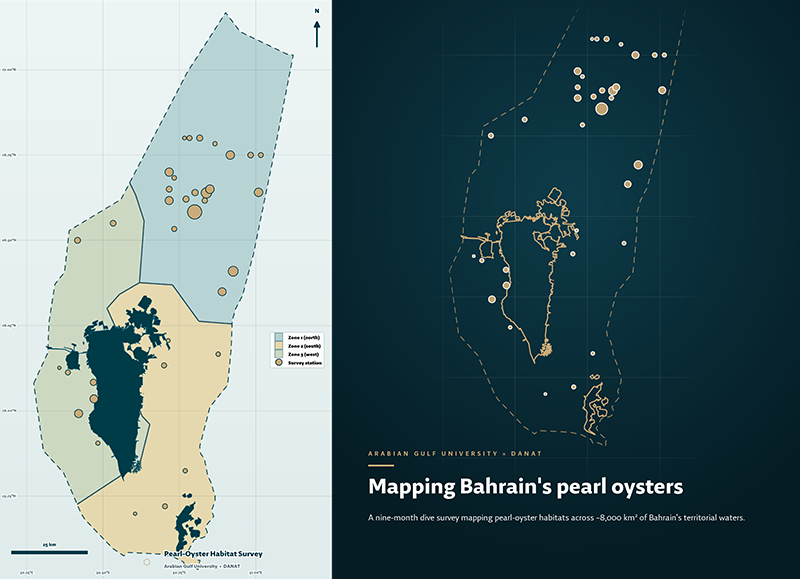
During the launch of “Danat’s” 2025 Sustainability Report, the release of the 2025 Greenhouse Gas Emissions Report, and the unveiling of the Al-Hairat Project initiative, that the research team overseeing the joint project on pearl oysters and seagrasses—which was launched as part of a strategic plan for marine data collection spanning from May 2025 to April 2026— conducted a comprehensive scientific survey of marine habitats in various regions of the Kingdom, focusing on pearl oysters and seagrasses, given the significant importance of these two ecosystems in maintaining marine ecological balance and supporting biodiversity and the stability of natural habitats.
She noted that this partnership was based on the complementary expertise of both parties; the university possesses specialized expertise in marine environmental studies, scientific consulting, geographic information systems and remote sensing, and state-of-the-art mapping techniques, while Danat Institute possesses extensive scientific expertise in surveying pearl oysters and studying their natural heritage habitats in the territorial waters of the Kingdom of Bahrain.
Dr. Al-Junaid explained that the working teams have so far completed the required field survey work, which spanned eleven months between 2025 and 2026. The survey covered most of the marine areas surrounding the islands of the Kingdom of Bahrain, covering an area of more than 8,000 square kilometers. She noted that the survey covered three main marine areas to facilitate the implementation of the survey work according to a rigorous scientific methodology, from which periodic samples were collected and are currently undergoing analysis at the laboratories of the Arabian Gulf University and Danat Laboratories.
She added: “The data collected is analyzed by specialists in environmental mapping, using high-precision data based on remote sensing, while ‘Danat’ experts identify the species and density of pearl oysters, enabling the creation of an accurate scientific database on the state of marine habitats in the Kingdom.” She emphasized that one of the project’s most important objectives is to study the capacity of these marine habitats to absorb and store carbon, as they are ecosystems that contribute to what is known as “blue carbon,” which supports the Kingdom of Bahrain’s efforts to fulfill its international environmental commitments, particularly under the Paris Climate Agreement, which urges all countries to reduce emissions and promote nature-based solutions for carbon sequestration.
She also noted that the project aims to establish a national scientific base and a specialized Bahraini research team that government agencies and national institutions can rely on in the future to prepare environmental studies, support policy development, and support plans for the management and conservation of marine resources in accordance with best scientific practices. She explained that this project serves as a model for integration between national and research institutions and reflects the Kingdom of Bahrain’s commitment to protecting its marine environments, preserving its pearl heritage, and promoting environmental sustainability for the benefit of future generations.