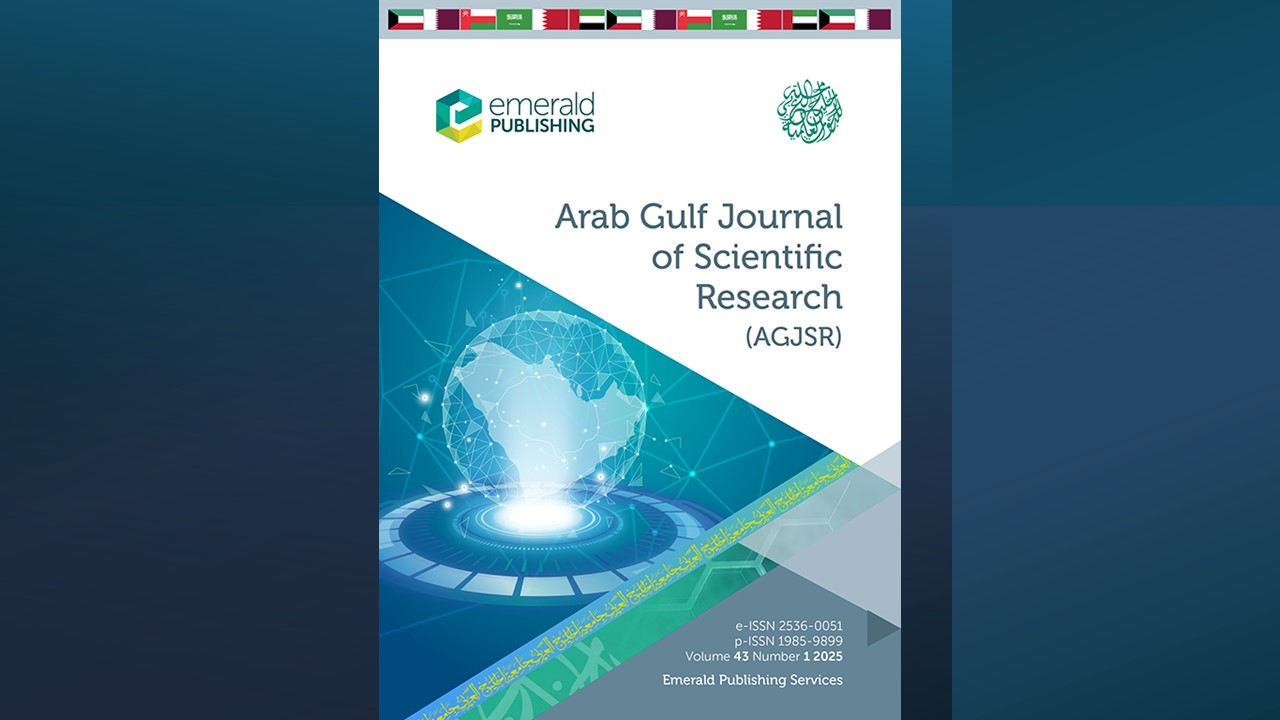
Arabian Gulf Journal of Scientific Research: Water, Energy, Food, and Environment Publishes Volume 43
Arabian Gulf University
13 Dec, 2025
The Arabian Gulf Journal of Scientific Research: Water, Energy, Food, and Environment (AGJSR-WEFE) has announced the publication of its latest issue, Volume 43, marking the first edition under its new focus and title.
In January, the journal adopted its new name following consultations with the publisher Emerald, to better highlight the Water, Energy, Food, and Environment (WEFE) nexus. This shift underscores its dedication to promoting multidisciplinary sustainable research that explores the complex interconnections among these critical sectors. The journal further achieved a milestone this year by advancing from the fourth quartile (Q4) to the second quartile (Q2) in international rankings, reflecting its rising academic prominence and regional leadership in sustainability research.
Since opening its submissions under the WEFE framework in February 2025, AGJSR-WEFE has continued to serve as an international platform for pioneering scientific research aimed at sustainable resource management, technological innovation, and environmental resilience.
Highlights of Volume 43 include an inaugural article outlining the journal’s new vision and expanded focus within the WEFE framework. The issue features research on groundwater quality for agriculture in Saudi Arabia’s arid regions, studies on effective leadership in achieving carbon neutrality, and predictive analyses on renewable energy adoption and green innovation in Oman. Additionally, the issue features an article discussing organisational innovation to balance technological advances with climate and geopolitical challenges, exemplifying the journal’s commitment to promoting sustainable practices and integrated resource management across WEFE sectors.
AGJSR covers topics such as sustainable resource management, renewable energy technologies, conservation strategies, regional and global food, water, and energy security; climate change impacts on WEFE including modelling, mitigation, adaptation, and carbon neutrality, particularly within the Arabian Gulf; space technology and geographic information systems (GIS) applications in WEFE, including earth observation, satellite technologies for climate monitoring, disaster reduction, and renewable energy planning.
Moreover, the journal includes a report on the role of circular waste management in WEFE, focusing on recycling, resource recovery, clean technologies, and the circular economy. Further topics encompass bio-applications such as bioremediation, bioenergy, sustainable agriculture, biofertilizers, and pollution mitigation as well as innovation for sustainability, highlighting green startups, sustainable urban development, green business models, and corporate social responsibility efforts aimed at enhancing WEFE resilience.
For more information and to access the full issue, please visit: