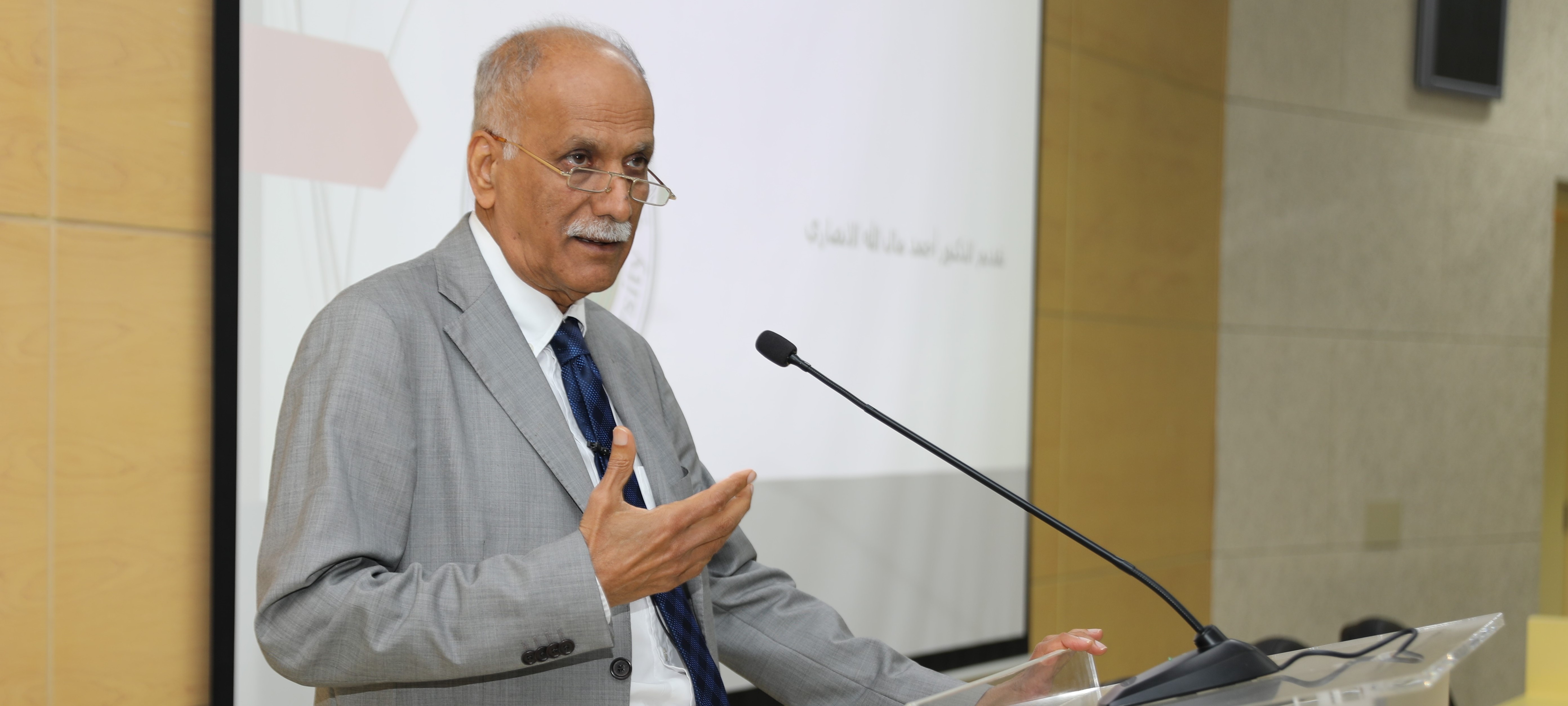
In a Lecture Titled "Job Burnout in Work and Study" Professor of Psychiatry at AGU: Burnout is a Challenge Threatening the Sustainability of Modern Workplaces
Arabian Gulf University
17 Jan, 2026
Professor Dr Ahmed Malallah Al Ansari, Professor of Psychiatry at the Arabian Gulf University (AGU) and Consultant in Child and Adolescent Psychiatry, stressed that emotional exhaustion has evolved into a growing systemic challenge.
"This shift requires institutions to re-evaluate prevailing work patterns and adopt comprehensive organisational solutions," he further added.
These remarks were made during his lecture, "Job Burnout in the Fields of Work and Study," organised by the AGU Centre for Consultation and Training in collaboration with the College of Medicine and Health Sciences.
Dr Al Ansari noted that the World Health Organisation (WHO) has classified emotional exhaustion in the International Classification of Diseases (ICD) as a syndrome resulting from chronic workplace stress that has not been successfully managed.
Dr Al Ansari further clarified the concept of job burnout, its symptoms, and the distinctions between burnout and clinical depression. He reviewed various treatment strategies and prevention methods aimed at promoting mental health and enhancing performance quality in both professional and academic environments.
He explained that emotional exhaustion manifests in three primary dimensions: the depletion of energy and a sense of constant fatigue, increased mental distance or feelings of negativism and cynicism related to one's job, and reduced professional efficacy. These indicators have become increasingly evident across several vital sectors, he explained.
"Recent statistics indicate that approximately 76% of employees experience emotional exhaustion at least occasionally, while 28% face burnout on a permanent or frequent basis," he revealed.
Dr Al Ansari pointed out that these percentages rise significantly in the healthcare and education sectors, where they range between 40% and 50%.
To illustrate the concept, experts often compare emotional exhaustion to a battery that is gradually drained; under the weight of burnout, work becomes a source of constant depletion that cannot be remedied by sleep or short breaks, leaving the individual in a state of continuous "low energy."
Dr Al Ansari explained that emotional exhaustion follows multiple patterns. These include classic burnout, which combines fatigue with cynicism and low achievement, and overextension burnout, where high achievement continues despite exhaustion. Other patterns vary in their degrees of fatigue and professional engagement.
He stressed that experts agree that addressing emotional exhaustion requires integrated solutions. On an individual level, this begins with setting clear work boundaries, taking genuine breaks, prioritising sleep and mental health, and seeking support when necessary. On an institutional level, it is crucial to manage workloads, promote autonomy, recognise employee efforts, and build a fair and supportive environment led by leaders who foster a culture of work-life balance.
Studies confirm that the prevention of emotional exhaustion is more cost-effective and efficient than its treatment. Institutions incur losses totaling billions of dollars annually due to decreased productivity and employee turnover.
In contrast, prevention programmes can achieve a return on investment (ROI) of up to three times their cost. The lecture concluded that emotional exhaustion is not an individual weakness but rather a direct result of imbalanced work systems. Therefore, addressing it is a shared responsibility that requires the concerted efforts of both individuals and institutions to ensure healthy and sustainable work environments.