Shaikh Hamad bin Khalifa Al Thani Chair in Geographic Information Systems (GIS) Hosts Dr Manaf Al-Khuzaei to Lecture on the Role of AI in Innovation and Technology Transfer
Arabian Gulf University
05 Jan, 2026
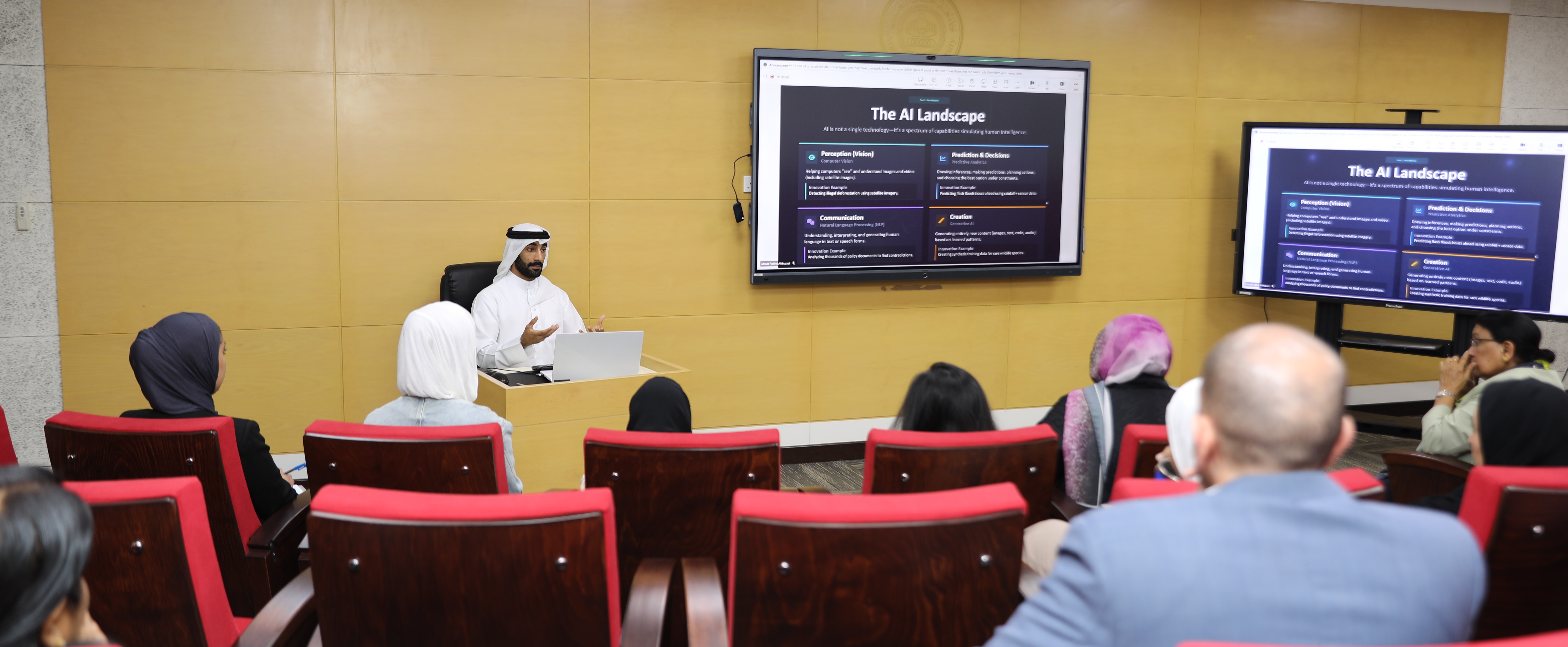
Dr Manaf Al-Khuzaei, GeoAI Remote Sensing Specialist in terrestrial and marine environments at Arabian Gulf University (AGU), delivered a lecture titled "An Introduction to Artificial Intelligence for Innovation and Technology Transfer" as part of the activities organised by the Shaikh Hamad bin Khalifa Al Thani Chair in Geographic Information Systems. During the session, he explained the fundamental concepts of AI and explored its applications in environmental fields and water resource management.
The presentation featured an overview of the theoretical and practical foundations of AI, highlighting the distinctions between machine learning, deep learning, and generative AI. Dr Al-Khuzaei supported his explanations with practical examples relevant to general and environmental applications.
The discission covered the core principles of AI and machine learning, stressing the differences between traditional programming based on fixed rules, and machine learning, which involves training models with data to generate intelligent outputs. Dr Al-Khuzaei noted that programming languages such as Python and Java are predominantly used in developing and implementing machine learning models.
He also discussed various types of machine learning, including supervised learning, unsupervised learning, and their practical applications including classification using labelled data, clustering to segment customers based on purchasing patterns, and regression models for predicting future values such as temperatures from historical data.
Dr Al-Khuzaei also reviewed the concept of deep learning and neural networks as advanced extensions of machine learning. These networks rely on multi-layered networks capable of learning abstract data properties, with practical applications in areas such as image segmentation and classification.
Furthermore, he addressed generative AI and large language models, demonstrating their capacity to generate content from textual prompts and automate tasks like summarisation and systematic analysis. He stressed the significance of prompt engineering to optimise outcomes.
In terms of practical applications, he reviewed the uses of AI in environmental fields and water resource management, such as environmental monitoring, water quality forecasting, flood prediction, and smart irrigation systems. He explained the role of machine learning models and data sources in improving operational efficiency and supporting decision-making.
He also discussed the challenges faced in implementing AI projects within the innovation chain, noting high failure rates often due to data quality issues. He affirmed the importance of adopting solutions by clearly defining problems, validating models, ensuring scalability, and actively involving stakeholders. He addressed ethical considerations, including data accuracy, sensor costs, transparency, accountability, and community participation.
He concluded by addressing cybersecurity and data protection concerns related to AI systems. He underscored the need for secure data handling, server infrastructure considerations, and awareness of risks associated with cloud-based services.