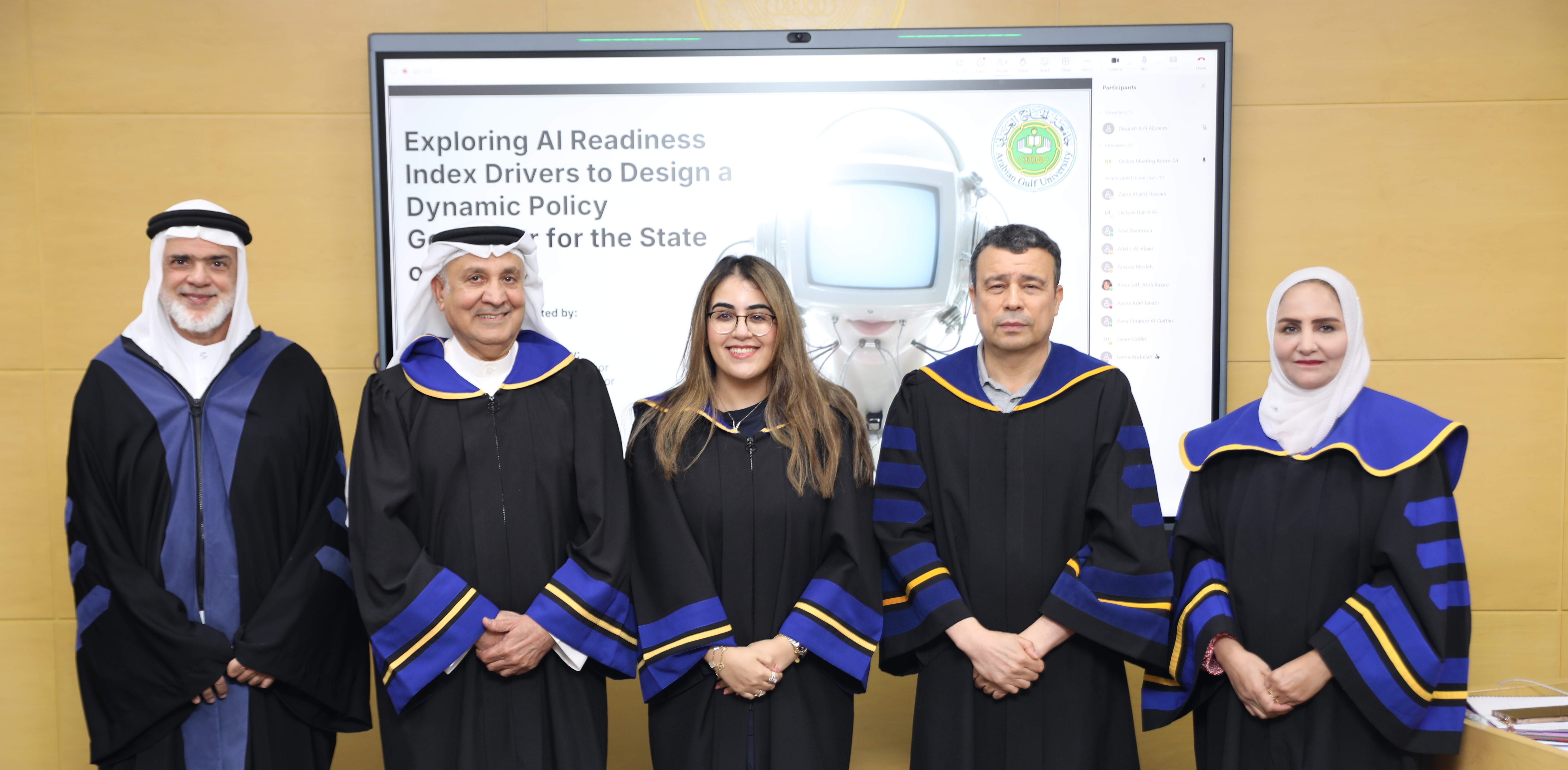
Researcher Noora Amer Al-Osaimi, from the Department of Innovation and Technology Management at the College of Education, Administrative and Technical Sciences at Arabian Gulf University, discussed the findings of her doctoral dissertation titled “Explori
Arabian Gulf University
24 Jun, 2026
Researcher Noora Amer Al-Osaimi, from the Department of Innovation and Technology Management at the College of Education, Administrative and Technical Sciences at Arabian Gulf University, discussed the findings of her doctoral dissertation titled “Exploring the Potential of the Artificial Intelligence Readiness Indicator to Design a Dynamic Policy Generator for the State of Kuwait,” as part of the requirements for obtaining a Ph.D. in Innovation Management at Arab Gulf University.
The study aimed to develop an innovative framework that addresses one of the most prominent challenges associated with global artificial intelligence readiness indicators, which largely rely on periodic assessments based on surveys, expert opinions, and manually updated data. Given the accelerating pace of digital transformation and the evolution of artificial intelligence technologies, there is a growing need for tools that are more flexible and capable of continuously adapting to change.
One of the dissertation's most notable contributions is the development of a model called the “Dynamic AI Readiness Policy Generator,” a dynamic tool designed to automatically link readiness assessment results to policies and implementation recommendations in a way that can be continuously updated based on available data. The model relies on automatic update mechanisms via application programming interfaces, drawing on live, continuous data from reliable international and national sources, including databases from the International Telecommunication Union and relevant telecommunications and technology regulatory bodies, as well as other official digital indicators. This enables a more continuous assessment of the level of AI readiness, as well as the generation of policy recommendations that can be updated whenever changes occur in the relevant indicators and data.
During the discussion, researcher Al-Osaimi stated that the model’s future vision extends beyond local borders, as the study seeks to expand its application to include the Gulf Cooperation Council (GCC) countries and then the Arab region, by adapting the operational mechanisms and verifying their effectiveness in collaboration with local experts, while taking into account differences in regulatory frameworks, innovative capabilities, and digital infrastructure. In its advanced stage, the project aims to build a flexible framework to support AI governance and public policymaking, thereby enhancing decision-makers’ ability to respond to technological and developmental changes.
For his part, the primary supervisor, Head of the Computing Department, and Professor of Computer Science, Cybersecurity, and Artificial Intelligence at the College of Education, Administrative and Technical Sciences, Prof. Dr. Adel Bouhoula, said that this scientific achievement reflects Arabian Gulf University’s commitment to supporting innovation and applied research that contribute to the development of advanced tools for public policy-making and the use of data to enhance countries’ readiness for digital transformation and artificial intelligence. He explained: “We are currently working to protect the intellectual property of the prototype, in addition to applying for funding grants, especially since the prototype has been developed and is already operational and is ready for implementation and future expansion.”
The examination committee consisted of Prof. Dr. Yousif Al-Bastaki, Professor of Information Technology and Computer Science at Al-Ahliya University, serving as an external examiner, and Prof. Dr. Adel Alawi, Professor of Business Administration and Information Systems at Arabian Gulf University, serving as an internal examiner, while the supervisory committee consisted of Prof. Dr. Adel Bouhoula, Professor of Computer Science, Cybersecurity, and Artificial Intelligence at the College of Education, Administrative and Technical Sciences, as primary supervisor, and Prof. Dr. Fayrouz Al-Damour, Professor of Management Information Systems in the Department of Business Administration at Arabian Gulf University, as co-supervisor.